Posts

The Theater, The Royal Tombs, The Great Temple and the Qasr al-Bint at Petra, Jordan

Image
Petra  is a historical archaeological city located in Southern Jordan . The capital city of the Nabataean Kingdom (3 rd Century BCE – 106 CE) during the 2 nd Century BCE, Petra was designated as a UNESCO World Heritage site in 1985 CE. Famous for the city’s Rock-cut architecture, Petra was designated as one of the “New 7 Wonders of World” in 2007 CE.

The mortuary temple of Queen Hatshepsut

Image
The mortuary temple of Hatshepsut  is a mortuary temple complex constructed during the reign of Pharaoh Hatshepsut (reign: 1479 BCE – 1458 BCE, Eighteenth Dynasty of Egypt). The Great Royal Wife of the Pharaoh Thutmose II (reign: 1493 BCE - 1479 BCE) whom she succeeded, Hatshepsut is the second recorded queen regent of Egypt, the first being Sobekneferu (a.k.a. Neferusobek), the last ruler of the Twelfth Dynasty of the Middle Kingdom of Egypt.

The Ajloun Castle in Jordan

Image
The Ajloun Castle (which was known as  Qal ʻ at ar-Rabad during the medieval period), is a 12th-century CE Muslim castle situated in the Ajloun Governorate in northwestern Jordan . The castle was originally constructed during the 12th Century CE by the Ayyubid Dynasty (1171 CE – 1341 CE), the founding dynasty of the medieval sultanate of Egypt. It was later expanded in the 13th Century CE by the Mamluk Sultanate (1250 CE – 1517 CE).

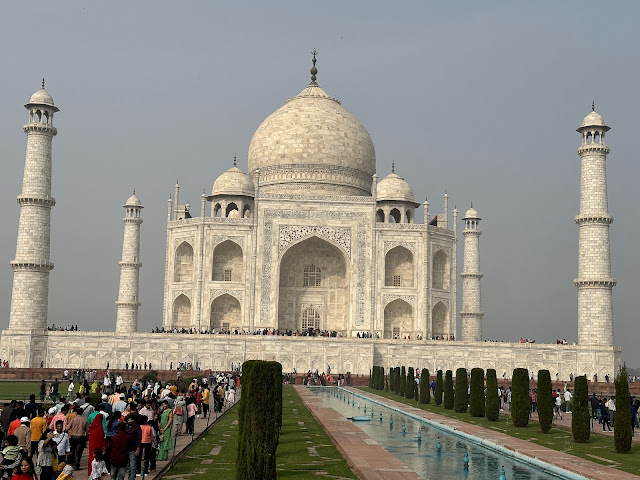
The Taj Mahal

Image
Commissioned by the Mughal emperor Shah Jahan (who was the emperor of Hindustan from 1628 CE to 1658 CE), to house the tomb of his wife Mumtaz Mahal (who died of postpartum hemorrhage in 1631 CE), the  Taj Mahal  is a white marble mausoleum which sits on the right bank of the river Yamuna , in the city of Agra , Uttar Pradesh, India.

Po Nagar temples in Vietnam

Image
Po Nagar is a Cham temple complex , located in the modern-day coastal city of Nha Trang in Vietnam. The complex is dedicated to goddess Yan Po Nagar , the founder of the Cham people according to legend.

Mỹ Sơn Sanctuary in Vietnam

Image
Mỹ Sơn is a group of ruined Hindu temples dedicated to the Hindu god Shiva . It is located in the Quảng Nam Province in Central Vietnam , about 69 km southwest of Da Nang. The temples were constructed between the 4 th and 14 th Century CE by the rulers of the Champa Kingdom (192 CE – 1832 CE). The rulers of Champa used Mỹ Sơn both as a site for religious ceremonies and as a burial place. Earlier structures in Mỹ Sơn are primarily attributed to King Bhadravarman I (reigned from 380 CE – 413 CE), King Sambhuvarman (reigned from 572 CE – 629 CE) and King Prakasadharma (653 CE – 687 CE). Later rulers continued the renovation of the old temples as well as continued the construction of new temples. Majority of the remaining structures were constructed by King Harivarman II (reigned from 989 CE – 997 CE) and King Harivarman IV (reigned from 1074 CE – 1080 CE).

The Obelisk Tomb, Bab as-Siq Triclinium and the Djinn Blocks at Petra

Image
Situated within the Petra archeological site in Jordan , The Obelisk Tomb is a burial complex carved by the Nabataean civilization during the reign of Malichus II,  who was ruler of Nabataea from 40 CE to 70 CE.

The Great Wall of China

Image
The  Great Wall of China  is a series of fortifications built across the historical northern borders of ancient Chinese States  and Imperial China. It served as protection against invaders, as well as a form of border control through regulating both trade (by imposition of duties on goods transported along the Silk Road) and travel (immigration and emigration). While several walls were constructed from as far back as the 7 th Century BCE , around 220 BCE under the reign of Qin Shi Huang , the first emperor of China (reign: 221 BCE – 210 BCE), sections of the earlier constructions were joined to form the original Great Wall.

The Giza Pyramid Complex

Image
The Giza pyramid complex  consists of the Great Pyramid of Khufu , the Pyramid of Khafre , and the Pyramid of Menkaure , their associated pyramid complexes and the Great Sphinx. All the structures within the complex are widely believed to have been constructed between 2600 BCE to 2500 BCE, during the Fourth Dynasty of the Old Kingdom of ancient Egypt . The complex was inscribed as a UNESCO World Heritage Site in 1979 CE.

Elephanta Caves

Image
The Elephanta Caves, also known as Gharapuri Caves, are a collection of cave temples primarily dedicated to the Hindu god Shiva. These ancient rock-cut shrines, considered to have been constructed between the 5th and 7th centuries CE are Located on Elephanta Island in Mumbai Harbour, India. The main cave at the island (also called the Great Cave) consists of a square court surrounded by cells and several entrances. The main entrance faces north, while two side entrances face east and west. The temple is enclosed in the cave with only interior walls, without an exterior wall. The Linga shrine of the Great Cave temple is a free-standing square stone cella (the inner area of an ancient temple), with entrances on each of its sides. Each door is flanked by two Dvarapalas (gate guardians) , for a total of eight around the shrine.

The Temple of Edfu

Image
  The Temple of Edfu is located on the west bank of the Nile in Edfu, Upper Egypt. The temple was built during t he Ptolemaic Kingdom of Egypt between 237 BCE and 57 BCE and was dedicated to the ancient Egyptian deities Horus and Hathor. Construction of the temple which stands today is estimated to have commenced during the reign of Ptolemy III Euergetes (reigned from 246 BCE to 222 BCE) and completed during the reign of  P tolemy XII Auletes (reigned from 80 BCE to 58 BCE,  and again from 55 BCE to 51 BCE). The current temple was constructed on the site of an older, smaller temple also dedicated to Horus. The older temple was probably constructed and used in the 19th dynasty , during the reigns of Ramesses I (reigned from 1292 BCE to 1290 BCE), Seti I (reigned from 1290 BCE to 1279 BCE) and Ramesses II (reigned from 1279 BCE to 1213 BCE). The temple was abandoned as a religious monument following the banning of non-Christian worship within the Roman Empire in 39...

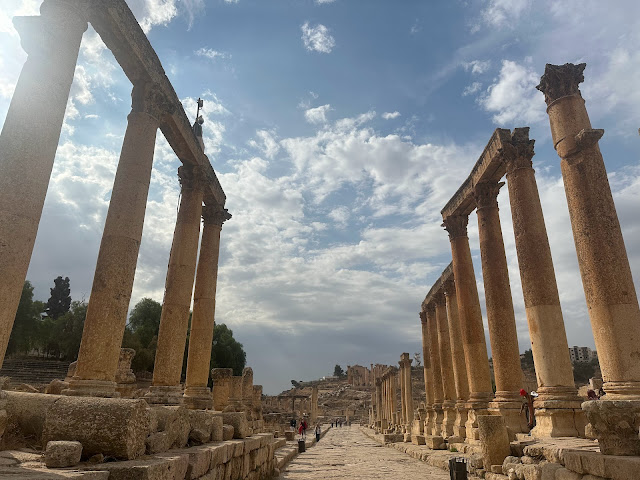
The Archeological Site of Jerash

Image
Located in northern Jordan,  Jerash  is one of the largest and most well-preserved sites of  Greek and Roman architecture  in the world outside Italy. While the earliest evidence of human settlement in Jerash dates back to 7500 BCE during the Neolithic age, the city flourished during the Greek, Hellenistic, Roman, and Byzantine periods until its’ destruction by the  Galilee earthquake in 749 CE  and subsequent earthquakes. The archeological site of Jerash

Ajanta Caves

Image
The  Ajanta Caves  are a group of rock-cut Buddhist cave monuments estimated to have been constructed from the 2 nd Century BCE to about 480 CE, located in the Aurangabad District of Maharashtra State in India. It is believed that the caves served as a monsoon retreat for monks, as well as a resting site for merchants and pilgrims in ancient India. The distant view of the Ajanta Caves The currently identified 29 caves constitute of monasteries (Viharas) and worship-halls (Chaityas) attributed to the Buddhist tradition. The interior of the caves also contains "Dry-Fresco" (paintings on top of a dry plaster surface rather than into wet plaster) depicting the past lives and rebirths of Buddha and rock-cult sculptures related to Buddhism. The caves which have been numbered for ease of identification based on the order they could be visited as opposed to the time of their construction have been attributed to two distinct periods. The earliest group of caves are generall...

Ad Deir (The Monastery) at Petra

Image
Ad Deir, widely known as the “The Monastery” is a mid-first century CE structure carved out of rock, in the ancient Nabataean city of Petra, located in modern day southern Jordan. Considered to be one of the largest structures in Petra, the Monastery is approximately 47 meters in height and 48 meters in width. Ad Deir (The Monastery) at Petra The Monastery is believed to have been constructed during the reign of Rabbel II Soter who was the last ruler of the Nabataean Kingdom, reigning for a period of 36 years from 70 CE to 106 CE. The architecture of the Monastery displays the classical Nabataean style , which is a blend of Hellenistic and Mesopotamian styles of construction.  The architecture of the Monastery displays the  classical Nabataean style The Hellenistic influence can be seen in the columns of the Monastery. The columns of the Monastery displays the  Hellenistic   style of construction The Mesopotamian style is evident in the single, large en...

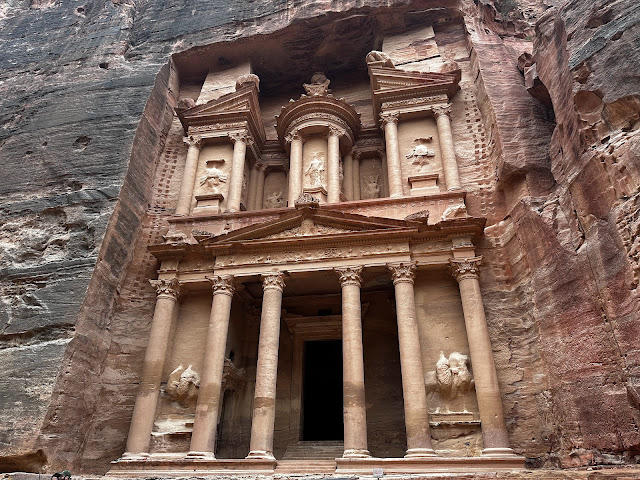
Al-Khazneh (The Treasury) at Petra

Image
Al-Khazneh, widely known as the Treasury is an elaborate rock cut tomb in Petra , a city of the Nabataean Kingdom (312 BCE – 106 CE) located in Southern Jordan . Al-Khazneh is estimated to have been constructed during the reign of the Nabataean King Aretas IV of Philopatris  (reigned approximately from 9 BCE to 40 CE). It  was carved out of a sandstone rock face and is estimated to be almost 40 meters in height. Al-Khazneh (The Treasury) at Petra The first glimpse of Al-Khazneh upon exiting the Siq, the narrow gorge which leads visitors into Petra The name Treasury is attributed to the legends surrounding the urn made of sandstone which sits high on the second level of the monument . The local Bedouins believed that the urn contained treasures. This myth is linked to the biblical legend of Moses and the Israelites escaping from Egypt. As per the local belief, the Egyptian Pharaoh and at least part of his army escaped the closing of the Dead Sea and continued after Mos...

The Amman Citadel in Jordan

Image
The Amman Citadel  is an a rcheological site  located in Amman, the capital of Jordan. It is considered to be among the world’s oldest continuously inhabited places, beginning from the Pottery Neolithic Period (5500 BCE – 4500 BCE), followed by the Chalcolithic Period (4500 BCE – 3300 BCE), the Bronze Age (3300 BCE – 1200 BCE), the Iron Age (1200 BCE – 539 BCE), the Persian Period (539 BCE – 332 BCE), the Hellenistic Period (332 BCE- 63 BCE), the Nabataean Period (312 BCE – 106 CE), the Roman Period (63 BCE – 324 CE), the Byzantine Period (324 CE – 635 CE), the Umayyad Period (661 CE – 750 CE), the Abbasid Period (750 CE – 969 CE), the Fatimid Period (969 CE – 1171 CE), the Ayyubid Period (1171 CE – 1263 CE), the Mamluk Period (1250 CE – 1516 CE), all the way up to the Ottoman Period (1516 CE – 1918 CE). The Amman Citadel Currently, majority of the structures still remaining within the Citadel belong to the Roman, Byzantine, and Umayyad periods.   These incudes the...

The Philae Temple Complex in Aswan

Image
The Philae Temple Complex is an island-based temple complex located in the reservoir of the Aswan Low Dam, downstream of the Aswan Dam and Lake Nasser, Egypt. Originally located on the Philae Island (believed to be one of the burying places of the ancient Egyptian god Osiris), the temple complex was dismantled and relocated as part of UNESCO’s "International Campaign to Save the Monuments of Nubia", to protect the monuments from the rising water levels of the Nile river. The temple complex is considered to be one of the best examples of the survival of pure Egyptian art, centuries after the last of the Pharaohs had ceased to reign over Egypt.  The first religious building on Philae is considered to be a shrine built by the 25th Dynasty Pharaoh Taharqa (estimated to have reigned from 690 BCE to 664 BCE) dedicated to the ancient Egyptian god Amun. However, the oldest temple known to have stood on the island was constructed by the 26th Dynasty Pharaoh Psamtik I (estimated t...